

This is Boondoggle, the newsletter about how corporations rip off our states, cities, and communities, and what we can do about it. If you’re not currently a subscriber, please click the green button below to sign up. Thanks!
Recent coverage here has examined both the connection between corporate subsidies and lobbying and the political science behind why politicians love a corporate subsidy deal. Today, to finish out the trilogy of sorts, I’m going to break down how corporate consolidation — one of the defining problems of our current economy — warps, distorts, and generally ruins efforts at good, local economic development.
Again, when I write “corporate subsidy” I mean public funds given to a specific corporation to locate a facility somewhere, or programs that are meant to encourage a certain form of economic activity, such as a film/TV tax credit program. States and localities annually spend tens of billions of dollars on these efforts, with little to nothing to show for it.
By “corporate consolidation,” I mean the shrinking of nearly every sector that has occurred in recent decades thanks to mergers, acquisitions, buyouts, and other sundry forms of contraction. A study released in 2015 found that 75 percent of industries had consolidated in the preceding two decades, a trend that has surely not reversed since.
The connection between the broad failures of corporate subsidies and corporate consolidation came to mind recently as I was reading more about California, where there’s a high-profile debate occurring about a proposed merger between entertainment giants Paramount and Warner Brothers.
Putting aside the other massive problems with the merger I couldn’t help but think about this through the lens of economic development, as the film and TV industry has historically been a major focus for tax subsidies (much to my chagrin).
A recent piece from the Media and Consolidation Research and Organization Lab at the University of California San Diego confirmed by concerns, arguing that should the merger go through it would give the newly formed “Paramount-Warner Bros.”massive power to extract tax subsidies from the many states that offer them for film production, as well as “weaken public bargaining power, [and] intensify interstate and international subsidy competition.”
Indeed, by eliminating a major competitor, consolidating business into certain regions, reducing the number of productions, and playing jurisdictions against each other for the remaining productions, the new company would increase its ability to extract public funds. This likely would occur through two avenues: Via it literally siphoning up more of the available dollars under existing programs, and then using its political influence to lobby for changes to these programs that would benefit itself.
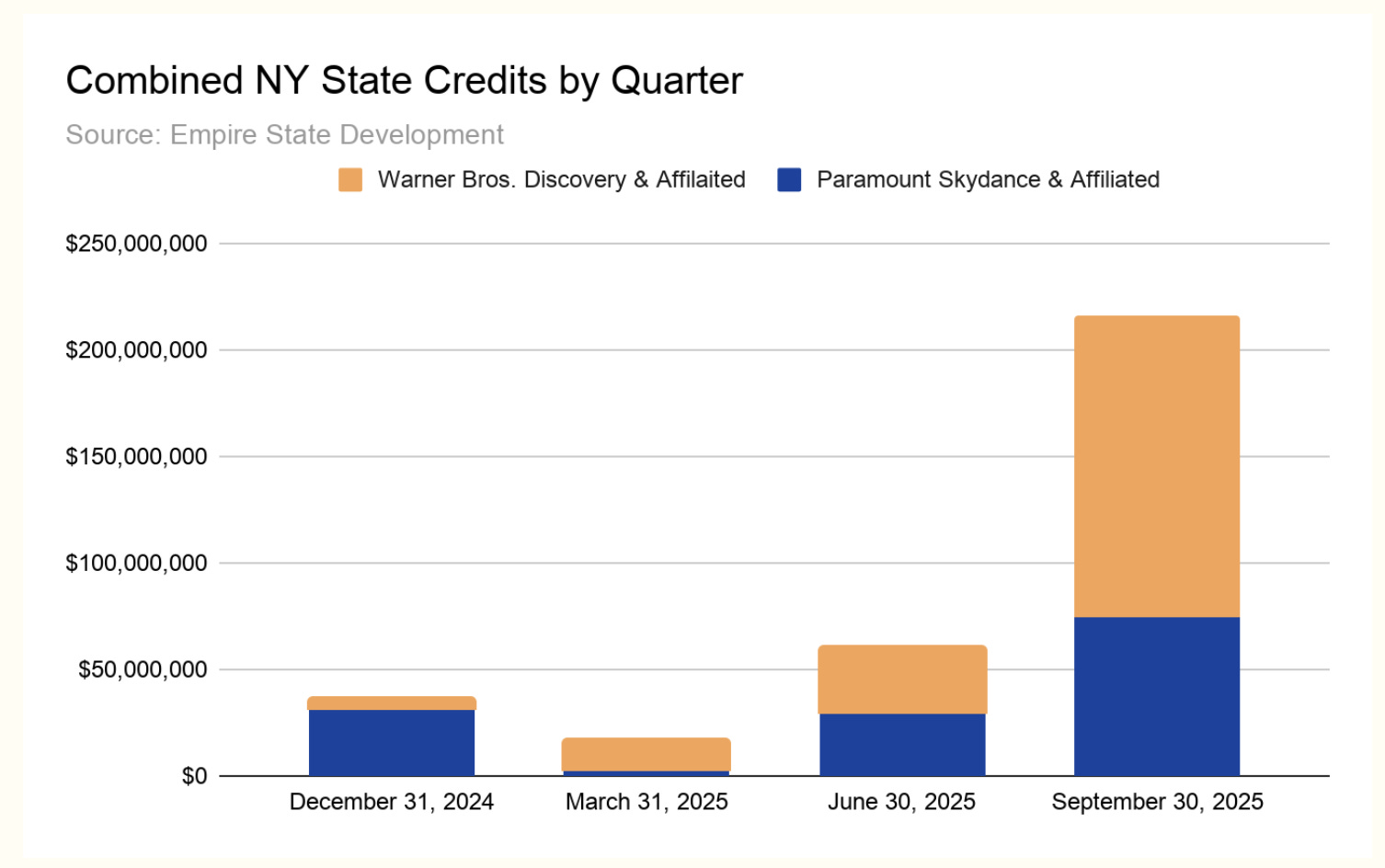
This isn’t only a California problem. In New York, for example, Paramount and Warner Bros. collected a combined $330 million in tax credits from the fourth quarter of 2024 to the third quarter of 2025 — from a program that totals about $1 billion annually.
It makes sense that, all else being equal, fewer available players in an industry would tip the scales toward the few reigning corporations and away from the public officials attempting to engage in local economic development efforts. Fewer competitors gives each individual player more leverage and makes the public officials or economic development bureaucrats on the opposite side of the table more desperate to claim their share of the shrinking pie, and thus more willing to attempt to outbid each other.
Consolidation also makes threats to leave a jurisdiction (a form of what’s known as a “capital strike”) carry more heft, as there are fewer potential replacements for lost facilities or economic activity. Large corporations have been effectively using such threats to gin up huge subsidy packages for decades, including Boeing, Amazon, and others. (Paramount, to return to our main character here, has claimed it will leave California if it can’t merge with Warner Bros.)
We already know that large corporations dominate economic development programs. A 2015 study of corporate subsidies in 14 states by Good Jobs First found that 90 percent of the money went to large corporations, while a 2020 survey found that “more than 30 percent of all establishments with over 1,000 employees receive discretionary subsidies, while the percentage is less than 0.2 percent for establishments with under 250 employees.”
The mechanics, though, are laid out in a 2024 study, which found that when the threshold for what constitutes a “small” business within a subsidy program increases, the money immediately starts to flow to those larger firms. As we can imagine, when larger competitors have their efforts paid for at public expense the small firms struggle to even compete. It’s in many ways a positive feedback loop. The small firms die out, while public funds help the big companies grow even bigger.
Both in writing my book and working on economic development reforms in recent years, I heard time and again that this was an issue. Leaders felt compelled to engage in a race to the bottom on economic development because the options were so few, the projects that were being proposed by large firms so theoretically transformative (think Amazon’s HQ2 or Foxconn’s Wisconsin plant, though neither turned out to be worthwhile in reality), and the political cost of being perceived as missing out on an opportunity was so potentially devastating.
More competitors, and more startups and entrepreneurs would alleviate the desperation to win any one particular project, reducing the leverage that the few large players hold and lessening their ability to act as if they are raining economic manna down from the corporate heavens with their every move.
None of which is to say that reversing our economy’s consolidation trends will fix our economic development struggles by itself — which is most definitely not the case — but it will help by making any individual corporate actor weaker within the overall system and making any single corporate investment decision less politically valuable.
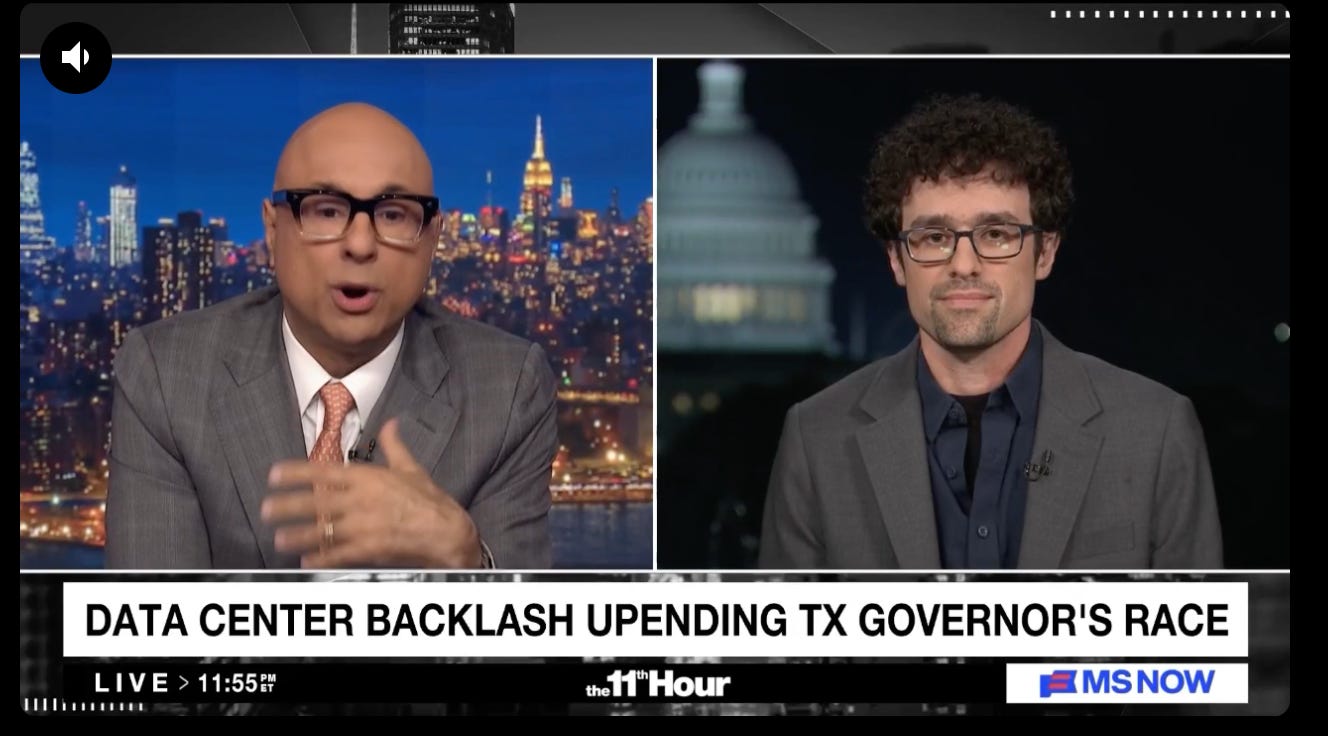
SHAMELESS SELF-PROMOTION: I went on MS NOW (formerly MSNBC) this week to talk about the political backlash against data centers and why data center tax breaks should be eliminated. You can watch it here.
SIMPLY STATED: Here are links to a few stories that caught my eye this week.
Meta (which owns Facebook and Instagram) agreed to an $18 billion settlement with more than 50 states and territories over claims that it exposed children to mental health harms and misled the public about the safety of its platforms.
Several states are offering tax penalty amnesties in an effort to collect unpaid back taxes.
A Nashville racing track is at the center of an intense local debate over economic development and public money.
Thanks for reading this edition of Boondoggle. If you liked it, please take a moment to click the little heart under the headline or below. And forward it to friends, family, or neighbors using the green buttons. Every click and share really helps.
If you don’t subscribe already and you’d like to sign up, just click below.
Thanks again!
— Pat Garofalo
This was interesting, written so that ordinary people can understand the methods and impacts, and very helpful in clarifying the issues as they affect local and national interests.