
Michigan's Mega-Deals Are a Warning to Everyone
Billions of dollars for only hundreds of jobs.

This is Boondoggle, the newsletter about how corporations rip off our states, cities, and communities, and what we can do about it. If you’re not currently a subscriber, please click the green button below to sign up. Thanks!
One of the main research findings regarding the effectiveness of state and local corporate subsidies is that they don’t create much in the way of positive economic outputs — job creation, GDP increases, poverty reduction, etc. — but they do increase votes for incumbent politicians. In fact, one of the most reliable ways to predict if a state is going to increase its corporate subsidy spending in a given year is to simply check and see if the incumbent governor is up for reelection.
(As a refresher, when I write “corporate subsidy,” I mean public money given to a specific corporation in return for opening a specific facility in a specific area, usually via a program authorized by a state legislature and overseen either by a state economic development agency or a governor.)
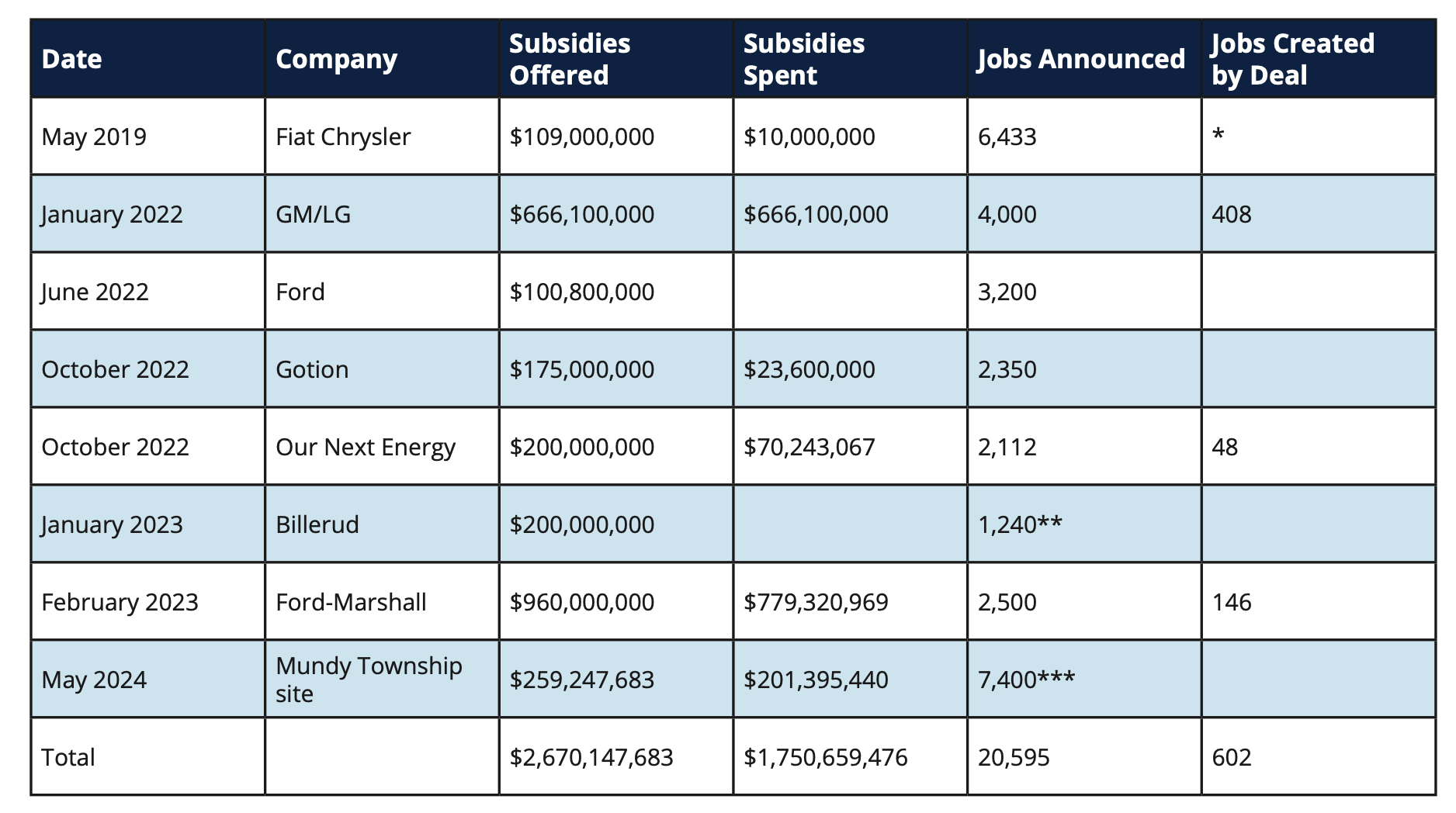
These facts were in my head as I read a new report from the Mackinac Center, a conservative think tank based in Michigan, about the record of current Michigan Democratic Gov. Gretchen Whitmer. According to the analysis by James Hohman, Mackinac’s director of fiscal policy, the Whitmer administration has pledged $2.7 billion to eight “generational” corporate subsidy mega-deals, which were supposed to create nearly 21,000 jobs in the state.
The actual record, though, is $1.8 billion spent for just 602 jobs, or about $3 million per new job. And even that understates the true failure. As Hohman wrote:
None of these deals have delivered what was originally announced. Two created only vacant fields. Two were canceled altogether. One deal has only a largely unused facility to show for it. Two others merely supported ongoing operations at existing auto plants that did not expand their operations. The most promising developments resulting from these deals are two battery plants that are still under construction but have already reduced their job targets from original expectations.
(Yes, this is a conservative think tank criticizing a liberal governor, but I know Hohman and he wouldn’t say anything different if Whitmer had an R after her name. He was, in fact, quite critical of a Republican administration that engaged in similar dealings.)
But these results will not likely hurt Whitmer or anyone associated with her administration. And while she may or may not have presidential or vice-presidential aspirations, she almost certainly benefitted in her current office from the impression that her corporate subsidy dealings were resulting in tens of thousands of new jobs.
Why? Announcing these deals garners elected officials positive press coverage, allows them to release glowing press releases and social media posts, and wins them plaudits from fancy CEOs and Chamber of Commerce types, all of which creates the impression that they’re having a positive effect on the economy, building the sort of political capital to which voters inevitably react.
This is particularly important for Democrats attempting to shake the perception that they and their party are “anti-business,” a moniker that has quite effectively stuck to them at all levels of government. Afterward, when those deals go bust, the press and the fancy people have already moved on, and the politicians themselves are potentially on to other things, too — much like Whitmer, who is term-limited.
To be clear, though, this is not really a story about Whitmer. She is simply the latest iteration of a bipartisan Michigan fascination with spending billions of dollars on subsidy deals with individual corporations — often large automakers — despite having very little to show for it. In the last two decades, Michigan leaders have authorized at least eight corporate subsidy deals worth more than $1 billion, and at least 50 worth $100 million or more. In that time, just 9 percent of the jobs promised to taxpayers actually arrived.
So there’s a vast gulf between the publicly reported-upon “success” of the programs that dole out those dollars and the actual output on the ground, and everyone is to blame, from the state legislators who created the programs, to the bureaucrats in the Michigan Economic Development Corporation who implemented them, to the governors who took credit for nothing worth having.
And to be even more clear, even if the Whitmer administration’s promises and projections became reality, it would have barely moved the needle in Michigan. Even if every promised job materialized, the cost to the public would have been about $130,000 per job. And 21,000 new jobs is barely a blip in the context of the entire Michigan economy, where nearly 850,000 jobs are created and eliminated annually. Fishing for mega-deals is simply never going to be worth the cost, as the supposedly large job numbers associated with them are a rounding error in the context of even the smallest state economies.
Other governors aren’t going to shy away from similar subsidy shenanigans, since it wins them votes and plaudits, but these numbers should serve as a warning to state legislators and advocates, who should have greater concern about the longer-term downsides of out of control corporate subsidy spending since they have other priorities they want funded in a zero-sum state budget.
Indeed, a bipartisan group of Michigan legislators have been working to put some guardrails around the state’s economic development practices, and the entire legislature managed to eliminate one of the most egregious programs during this year’s budget process. Even the candidates seeking to succeed Whitmer next year have felt the need to pay lip service to reforms (though I doubt they’d hold those commitments were they to inhabit the governor’s mansion).
It’s not unheard of for a faulty corporate subsidy deal to be a governor’s downfall: Wisconsin Gov. Scott Walker in 2018 lost re-election, in part, because of the spiraling costs of a deal with the Taiwanese manufacturer Foxconn. But that’s been the exception rather than the rule. Making it the rule, though, is key to building an economic development system that works for local communities, rather than corporate behemoths.
UPDATE(S): Two issues I work on and follow here had some positive developments last week, as Illinois became the seventh state with a comprehensive ban on junk fees and Rhode Island became the second to ban the restrictive deeds large grocers use to block new stores from opening.
SIMPLY STATED: Here are links to a few stories that caught my eye this week.
Gov. Maura Healey announced that Massachusetts is the latest state to implement a temporary pause on new data center tax incentives. (More on this issue here.)
Atlanta’s mayor has instituted a temporary moratorium on new self-storage facilities.
The Michigan House approved a bipartisan bill to limit large investor purchases of single-family homes.
“Tech giant Oracle is suing the Public Service Commission of Wisconsin over financial requirements for data centers.”
Thanks for reading this edition of Boondoggle. If you liked it, please take a moment to click the little heart under the headline or below. And forward it to friends, family, or neighbors using the green buttons. Every click and share really helps.
If you don’t subscribe already and you’d like to sign up, just click below.
Thanks again!
— Pat Garofalo