
Study Shows Corporate Subsidies Only Create Jobs for Lobbyists
More tax handouts, more lobbying jobs in state capitols.
This is Boondoggle, the newsletter about how corporations rip off our states, cities, and communities, and what we can do about it. If you’re not currently a subscriber, please click the green button below to sign up. Thanks!
Today’s post was written by Maxine Adelson, an intern at the American Economic Liberties Project.
The promise of corporate “economic development” subsidies is that they will create new jobs. Indeed, elected officials, government agencies, and the corporate executives that receive them all defend these public dollars flowing to private interests in the same way: As investments in local job creation and economic growth.
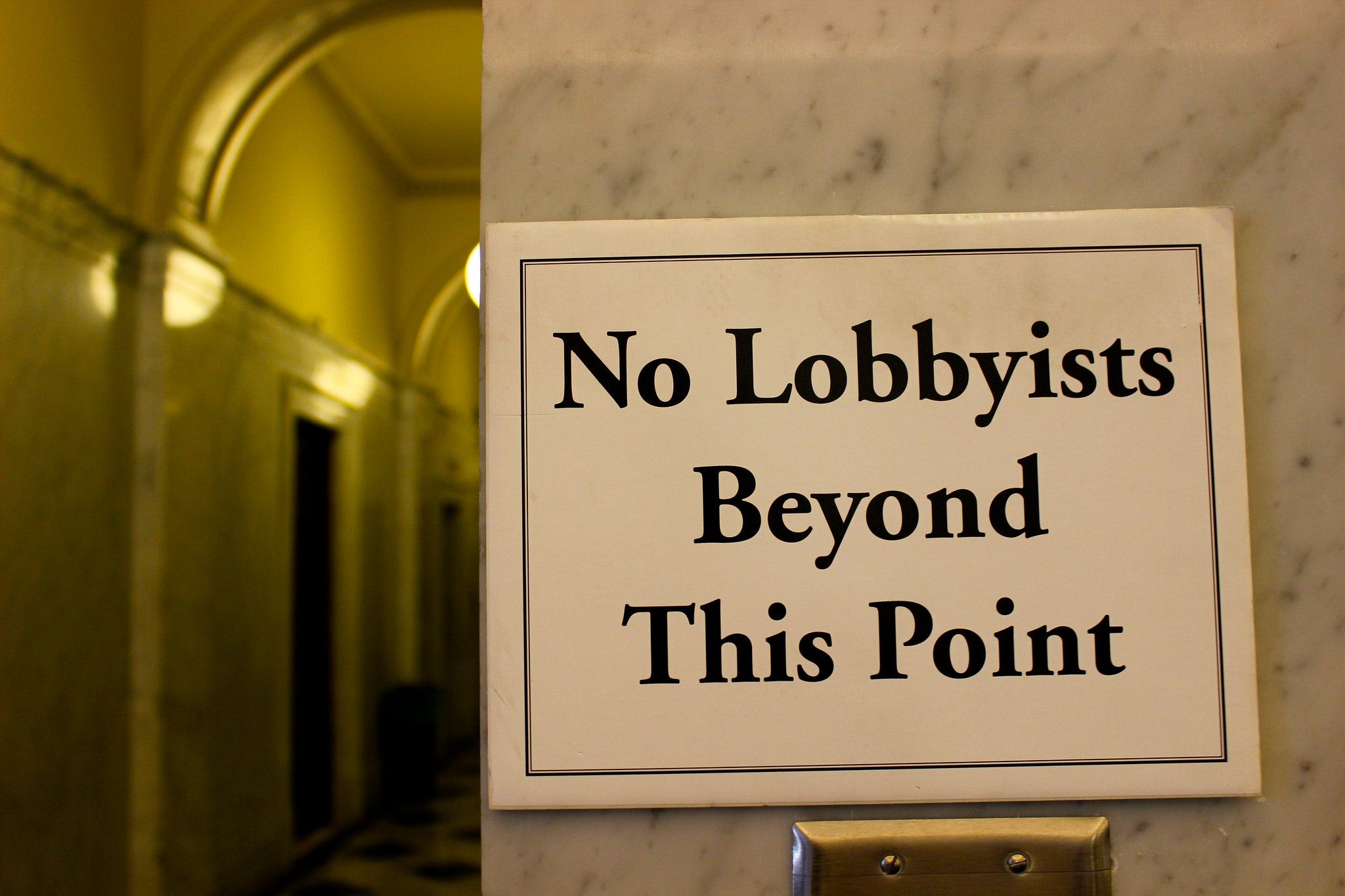
Research shows that this promise routinely isn’t kept. But a new study suggests that one industry does, in fact, see meaningful job creation from such subsidies: The lobbying industry.
Researchers Russell Sobel, Gary Wagner, and Peter Calcagno tracked data from more than 40,000 lobbying firms, covering all 50 states from 1997 to 2019. They examined what happened in a state before and after it handed out an “extraordinarily large” incentive — defined as a subsidy thousands of times bigger than that state had ever given before — and compared that to states that never awarded such an extraordinarily large incentive.
The study found that in the years after a state hands out its first extraordinarily large incentive, lobbyist employment in that state rises 3.6 percent on average. The effect is sharper in the state capital: In the five years following the incentive, lobbying firms in the capital county see employment gains of 4.5 percent relative to capital counties in comparison states. Additionally, lobbying’s share of the capital county’s private-sector workforce grew by 5.8 percent.
“Rather than accomplishing their stated goal of promoting productive economic activity, extraordinarily large incentives lead to the allocation of resources toward a path of unproductive activity,” the authors wrote. I.e., instead of creating new, sustainable economic activity that actually helps a locality, incentives just stimulate more political horse trading and dealmaking.
The researchers checked whether this result occurred due to some fluke regarding how they drew the line — maybe a handful of extreme cases were driving the whole result. However, the effect holds whether the threshold for “extraordinarily large” is set at 2,000 times a state’s historical median or 5,000 times. It also holds up when neighboring states are removed from the comparison, ruling out the possibility that one state’s mega-incentive was triggering a copycat incentive war nearby that would throw off the results.
Even then, the study managed to simultaneously undercut the normal economic development argument, as the researchers found no evidence of new lobbying firms opening. Instead, all of the gains are captured by existing lobbying firms expanding their businesses.
This is likely not what proponents of these deals intended, but it tracks with what other research on economic development deals has revealed. Sobel, Wagner, and Calcagno looked at this from another angle in 2022, and found that states offering extraordinarily large incentives saw a spike in campaign contributions and in the reelection odds of the politicians who approved them. Interpreted together, the two studies show a pattern: When a state awards a company an outsized incentive, the gains tend to flow to the recipient firms’ lobbying, to their shareholders, and to the incumbent politicians who approved the deal.
Separate research has found that firms that put more resources into the political process are more likely to land these incentives in the first place, suggesting the lobbying isn’t just a side effect of winning a deal, but a key part of obtaining it in the first place.
All of this sits on top of decades of research showing that these incentive programs generally fail to produce the job growth, income gains, or tax revenue they promise. Yet, that has not stopped states from handing out more of them: State governments now spend more than $40 billion a year on these incentives — three times what they spent in 1990.
The non-monetary costs of these giant corporate giveaways — the lobbying, the corruption risk, the talent and resources diverted away from actually building something new and innovative — are real, but they are notoriously hard to quantify, so tend to get left out of the political conversation. And in most states, no one is even checking to see what sort of economic activity public dollars are buying, as state agencies rarely follow up and assess their incentive programs.
Of course, lawmakers should reconsider handing out incentives at this scale in the first place. But there are other fixes worth pursuing, too.
For example, states could require extra legislative review for any extraordinarily large incentive, instead of letting them get waived through under existing program authority. States could also mandate the kind of follow-up assessment that, as the study notes, almost never happens. And to make the reality of the situation abundantly clear, they could require anyone who is paid to help a company pursue one of these subsidy deals to register as a lobbyist.
No voter ever asked for a job creation program focused on lobbying firms in and around their state capitol, but it turns out that’s what they’re receiving instead of programs that focus on local workers, businesses, and their actual needs.
SIMPLY STATED: Here are links to a few stories that caught my eye this week.
New Jersey Gov. Mikie Sherrill signed a law banning the use of surveillance pricing in the grocery industry. (Background on this issue here.)
A Philadelphia tenant filed the first case under the city’s recent law against algorithmic collusion in rental housing.
A federal judge blocked Minnesota’s first-in-the-nation law to ban prediction markets. (Background on this issue here.)
“How Meta Got Everything It Wanted in a Secret Louisiana Data Center Deal”
Thanks for reading this edition of Boondoggle. If you liked it, please take a moment to click the little heart under the headline or below. And forward it to friends, family, or neighbors using the green buttons. Every click and share really helps.
If you don’t subscribe already and you’d like to sign up, just click below.
Thanks again!
— Pat Garofalo
 |
|
Glad handing, horse trading, plain envelopes passed under the table; nothing to see here, just doing the peoples' business.
My little town is canoodling with CONsultants selling special taxing districts for a convention and event center plus hotels to attract "high impact regional events". Said events remain undefined but I've a good idea what the final CONsulting report will recommend. Approval will be unanimous with zero real discussion.