
What We Can Learn from New Jersey's Fight Over the World Cup
Stand up to the sports event industrial complex.
This is Boondoggle, the newsletter about how corporations rip off our states, cities, and communities, and what we can do about it. If you’re not currently a subscriber, please click the green button below to sign up. Thanks!
The 2026 World Cup, co-hosted by the United States, Mexico, and Canada, begins in just a few weeks. In this pre-tournament buildup, though, the fiercest battle is not between two teams on any pitch or coaches in the media, but between FIFA, world soccer’s governing body, and the state of New Jersey.
Specifically, FIFA is aggrieved that New Jersey Transit, which among other things connects northern New Jersey with New York City, reportedly intends to charge more than $100 for a trip between Manhattan and MetLife Stadium in New Jersey’s Meadowlands, which will host several tournament games, including the final. FIFA has warned that such costs will have a “chilling effect” on tournament attendance.
(This is the point at which I am morally obligated, as someone who grew up in New Jersey, to note that though “New York” is named as a host in the tournament’s materials, no World Cup soccer is actually being played anywhere in the Empire State, with all the “New York” games actually taking place in New Jersey.)
New Jersey Gov. Mikie Sherrill has defended those high prices saying she refuses to foist the cost of hosting the tournament — including for security and running extra transportation — onto New Jersey taxpayers. "FIFA is making $11 billion off this World Cup," Sherrill said. "FIFA should pay for the rides, but if not, I'm not going to let New Jersey commuters get taken for one."
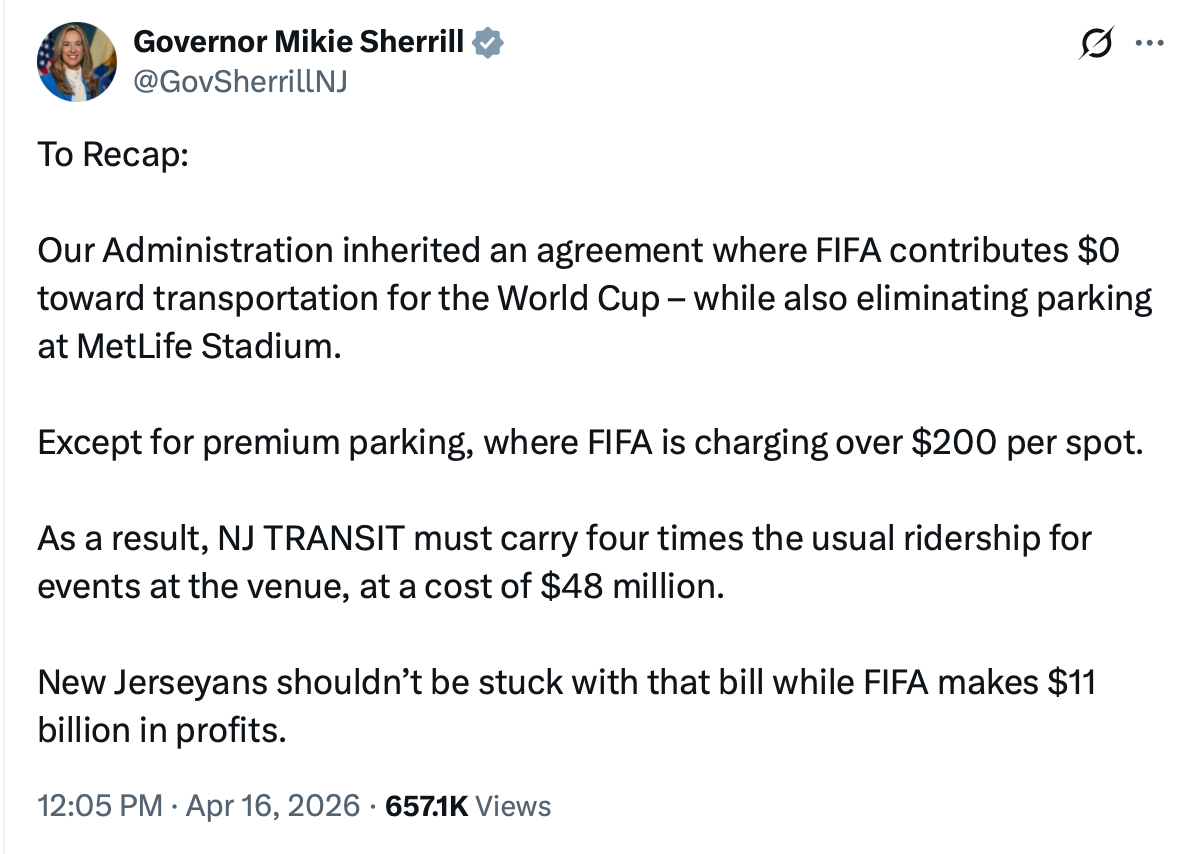
This is the clearest recent example of a government official pointing out the obvious: Hosting a major sporting event such as the World Cup is an economic liability, not a benefit, and should be treated as such. Sherrill is right to demand compensation for the costs New Jersey will accrue, and more jurisdictions should be doing the same, pushing back in specific ways on the sports event industrial complex.
Ample research shows that the World Cup specifically — and major sporting events such as the Olympics or the Super Bowl, generally — don’t boost local economies. The academic consensus regarding the World Cup is that “the observed impact of the World Cup has been a fraction that touted by the event boosters, and frequently the observed impact has actually been negative.” Indeed, the last time the U.S. hosted the men’s version of the tournament, in 1994, host cities saw drops in income that totaled billions of dollars.
That effect occurs because of the costs associated with hosting, including the aforementioned transit and security costs, as well as the economic effects I detailed here and here, which boil down to World Cup tourists replacing some pre-existing percentage of tourism activity rather than adding only new spending, as well as simply redirecting entertainment spending that would have occurred under normal circumstances.
The fact that the World Cup will be an economic dud seems to be sinking in on some level not just in New Jersey but across the country, as there’s been a slew of reporting in recent days about an impending World Cup “bust” for host cities.
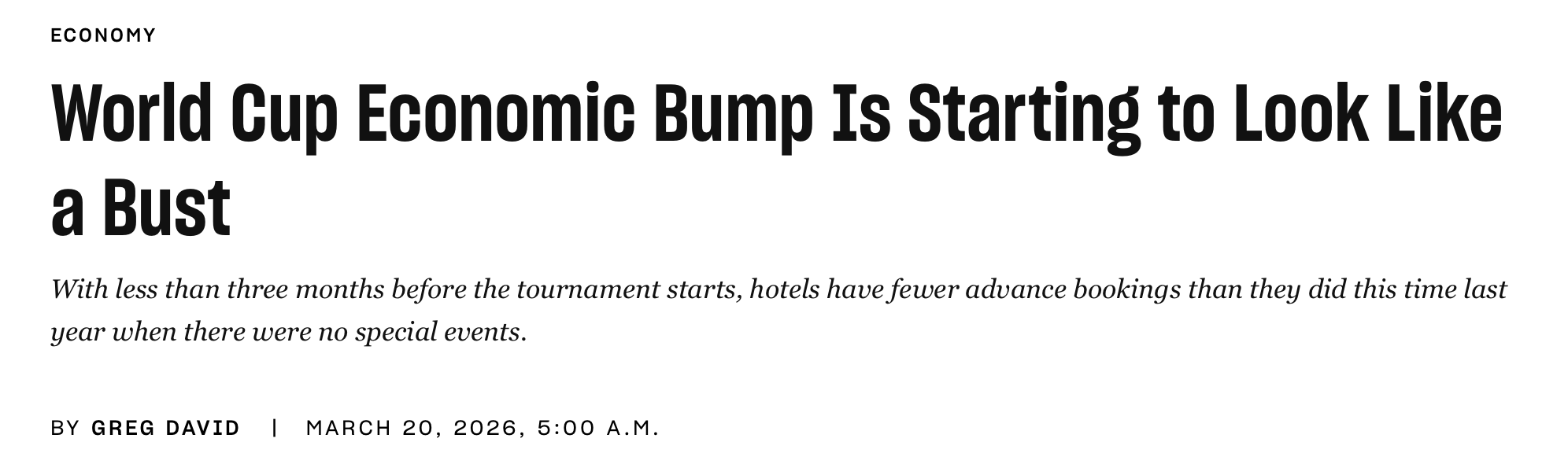
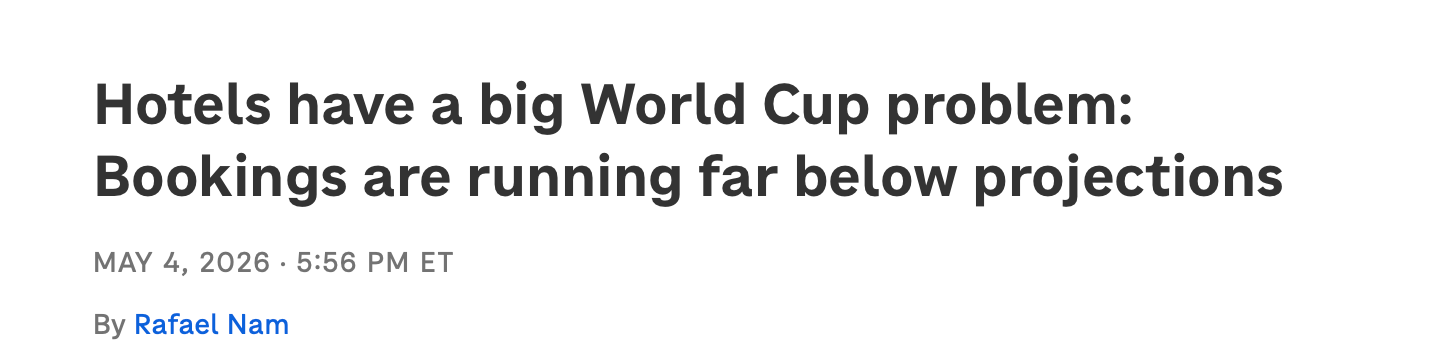
For New Jersey, specifically, this issue will likely be amplified, as much of the outside spending done by World Cup tourists will presumably occur in nearby New York City, accruing no benefit to New Jersey at all, or within the confines of MetLife Stadium, where the bulk of the money will wind up going to corporate vendors or FIFA itself.
Indeed, FIFA has no legs to stand on when it comes to complaints of price gouging or a “chilling effect” due to high prices. In the run-up to the tournament, there has been justified complaining about the ways in which FIFA has priced and distributed tickets, mostly due to its use of dynamic pricing (which constantly changes prices in real time) and manipulation of the market via selective seat releases and deceptive advertising aimed at duping folks into buying more expensive tickets before cheaper ones became available. Ticket sales for some games have been very slow.
New Jersey also wasn’t the only World Cup host dealing with a cost kerfuffle. Foxboro, Massachusetts, threatened to cancel matches at Gillette Stadium unless it received reimbursement for its security costs — a threat that worked, as FIFA’s local partner agreed to pony up the funding.
Now, some folks are already trying to blame any impending World Cup economic bust not on FIFA or the simple economic reality of major sporting events, but on the Trump administration’s threats against participating countries and immigrants, difficulties faced by fans in obtaining visas, or our current economic doldrums and high gas prices.
To be clear, those can definitely play a role in depressing turnout, but even absent those factors there was no reason to believe the World Cup would provide the flow of benefits boosters claim, because other major sporting events, all of which occurred under wildly different economic conditions, haven’t delivered them either. The through line is overblown booster and politician promises that can’t overcome economic realities.
We had a preview of this during the recent National Football League Draft in Pittsburgh, Pennsylvania — not subject to the same Trump administration jawboning! — where local business owners who were promised an influx of profits instead saw underwhelming demand, and the city itself likely paid more than it got back for the privilege of hosting.
This is simply what happens at major sporting events, and yet too many politicians, local leaders, and journalists refuse to learn the lesson. I also, to be clear, don’t know what sort of line Sherrill is going to hold or if she’ll cave for some sort of peanut offer.
Her calling out FIFA is something though. Next time around more politicians and local leaders should demand FIFA — or the International Olympic Committee, or the National Football League, or whoever — shoulder the costs that are currently being born by taxpayers and local communities. Sherrill opened the door a crack, and others need to walk through it.
SIMPLY STATED: Here are links to a few stories that caught my eye this week.
Pennsylvania Gov. Josh Shapiro is calling for some smart reforms to monopoly utilities.
The Washington State attorney general sued Albertsons grocers for allegedly using fake “buy-one-get-one-free” sales.
A lawsuit charges that the Missouri marijuana market is run by an “illegal cartel.”
Five more states joined a case seeking to block a merger between Nexstar and Tegna, which would create a local journalism behemoth.
Thanks for reading this edition of Boondoggle. If you liked it, please take a moment to click the little heart under the headline or below. And forward it to friends, family, or neighbors using the green buttons. Every click and share really helps.
If you don’t subscribe already and you’d like to sign up, just click below.
Thanks again!
— Pat Garofalo
This is why I voted for the governor.
Well said, Pat. As a resident of “Noo Joisey” I am disgusted by the FIFA scam (and by the teams that deceptively label themselves as “New York”).